From HSK 3.0, the HSK 2 exam has a writing section for the first time. Don’t panic: the writing list is only 100 characters, and they’re ones you should probably know how to write anyway, even just to help your reading later on.
In this post we’ll walk through what the HSK 2 writing exam actually tests, the tips Fiona picked up from official mock papers, publishers’ mock exams and the workbook tests, and how to practise with Skritter’s new handwriting decks. We’ll be making a writing-exam video for each level, starting with this one.
For the wider changes in HSK 3.0, see our earlier post, New HSK 3.0 word lists explained.
The writing list is smaller than you think
They only test writing once you get to HSK 2, but the list is called HSK 1-2 because it includes all the characters you need for that level 2 exam. The main HSK 2 list has 500 words. The writing exam covers 100 single characters, not 100 words.
That’s to your advantage for exam prep. They obviously expect you to read many more characters than you need to write by hand. In the old HSK, the writing section didn’t begin until level 3. Now it starts at HSK 2, but with a much shorter list.
What’s in the HSK 2 writing exam?
Fiona went through the official mock papers, the mock exams from publishers, and the short tests at the end of each lesson in the HSK textbook workbooks, so you don’t have to. The exam is split into two parts, with five questions in each.
Part 1: put the missing component back
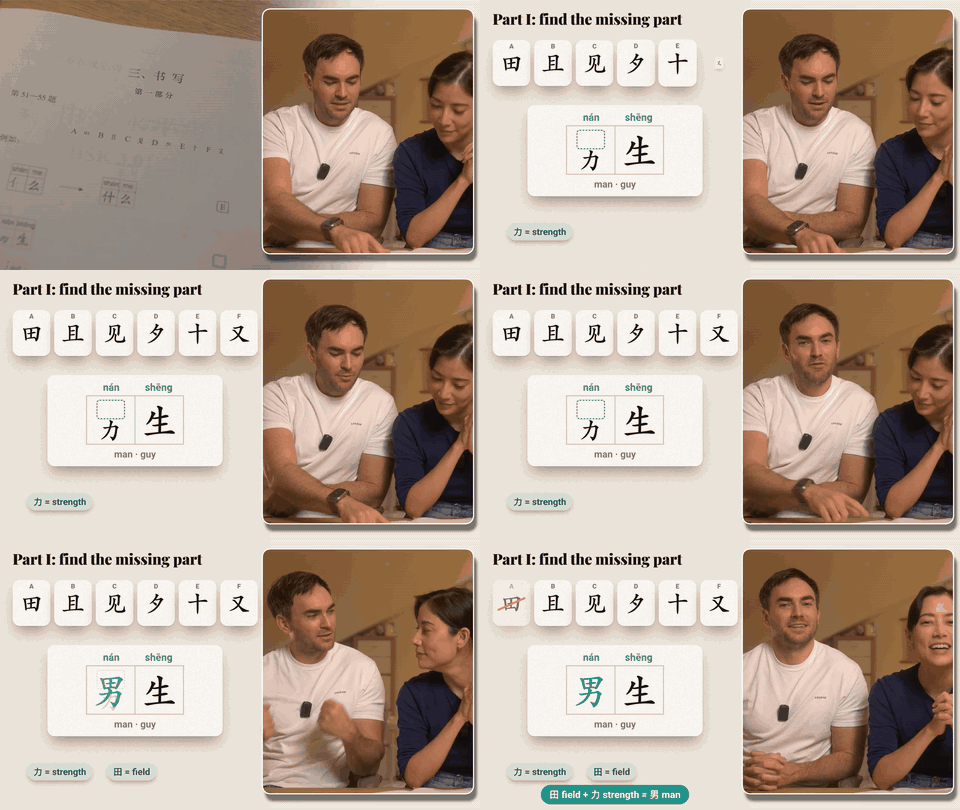
You’re first shown six components. These are only parts of a character. Then you get five questions. Each question is usually two characters, so you can see the context of the word, but one of the characters has something missing. You have to pick the right component from the list and put it back in its correct home.
Take 男生 (nánshēng), “guy” or “man”. The first character is missing a part: at first you only see 力, which means strength. Which component goes on top to make “man”? It’s 田 (field). A handy mnemonic is that 男 (nán) is “strength in a field”.
Part 2: fill in the blank
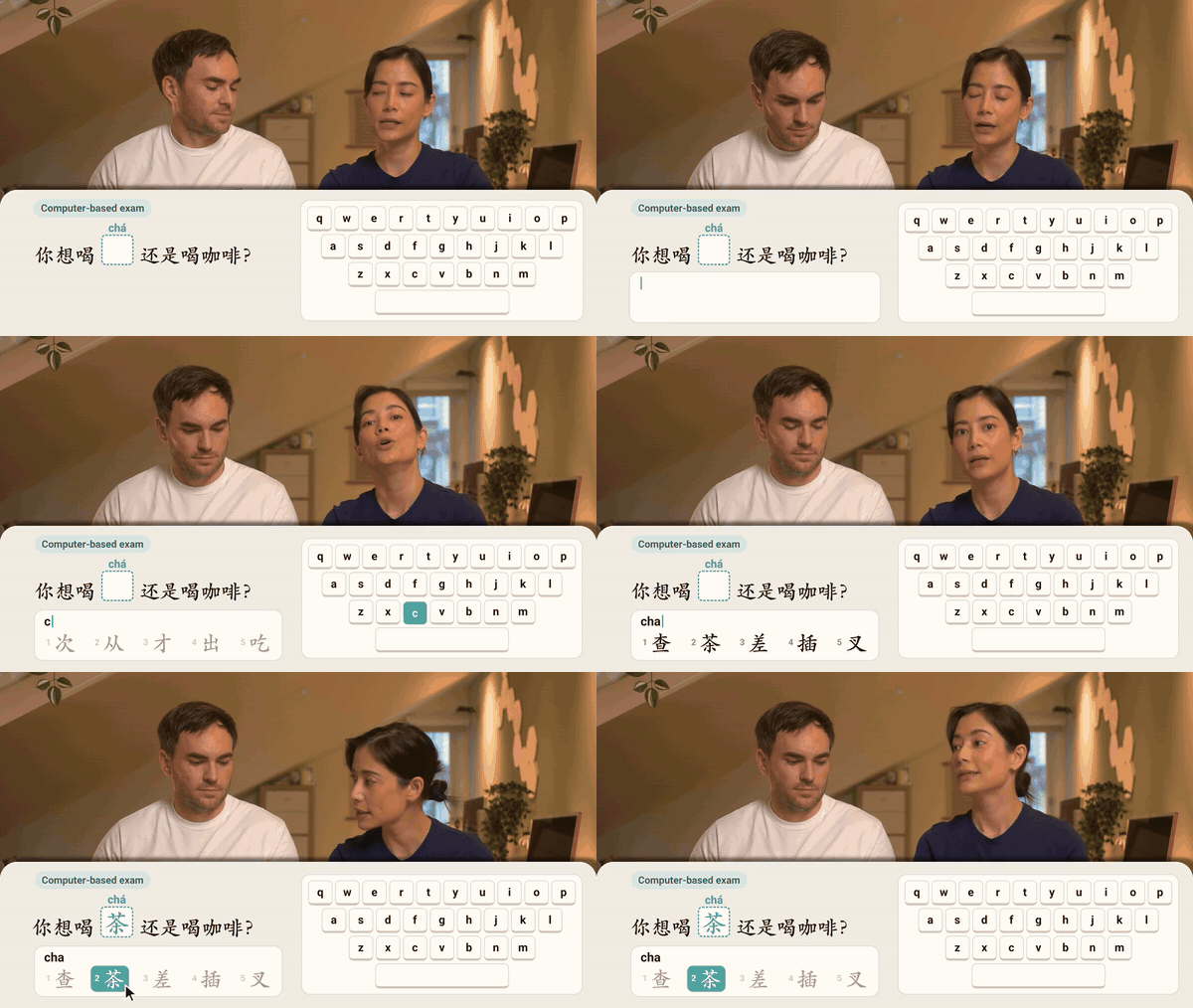
Part 2 is more like a classic fill-in-the-blank. You get five sentences, each with one character removed, and you have to write it in. You also get a bit of help: the sound of the character is given, so you already have a clue as to what belongs in the blank.
If you sit the paper exam, you write the character by hand. There are computer-based options too. Fiona’s understanding, ahead of the first official HSK 3.0 exam on 13 December 2026 and the official rollout in January 2027, is that on a computer you would type the pinyin and select the correct character. That’s theoretically easier than writing it out, but you still need to know which character to pick. Reports from the first sittings aren’t in yet, so this post assumes you’re taking the handwritten exam.
Three tips for Part 1
1. Know what components mean
It can feel like extra work at the start, but a basic sense of what components mean already gives you a clue. If a component has water, it generally relates to something wet or liquid. If it has a woman, it generally refers to birth or women. If it has a walking component, it generally refers to movement. You can often make a strategic guess from the context of the character.
2. Look at where the gap is
Certain components only ever live in one or two places. 辶 (chuò), which means to walk or move, only ever sits on the left, with the “foot” extending underneath the character. If the blank has space for that shape, you know it’s a strong candidate. 女 (nǚ), when it’s the slim form, only ever lives on the left. Sometimes a fatter form sits at the bottom, as in 要.
Once you start to see how components fit inside characters, you can often get there by process of elimination. Put in the ones you’re confident about, cross them off, then deduce the rest from meaning and placement. Fiona’s view is that you could already get halfway, if not 80% of the way, through these five questions on meaning and placement alone.
3. Watch for look-alike components
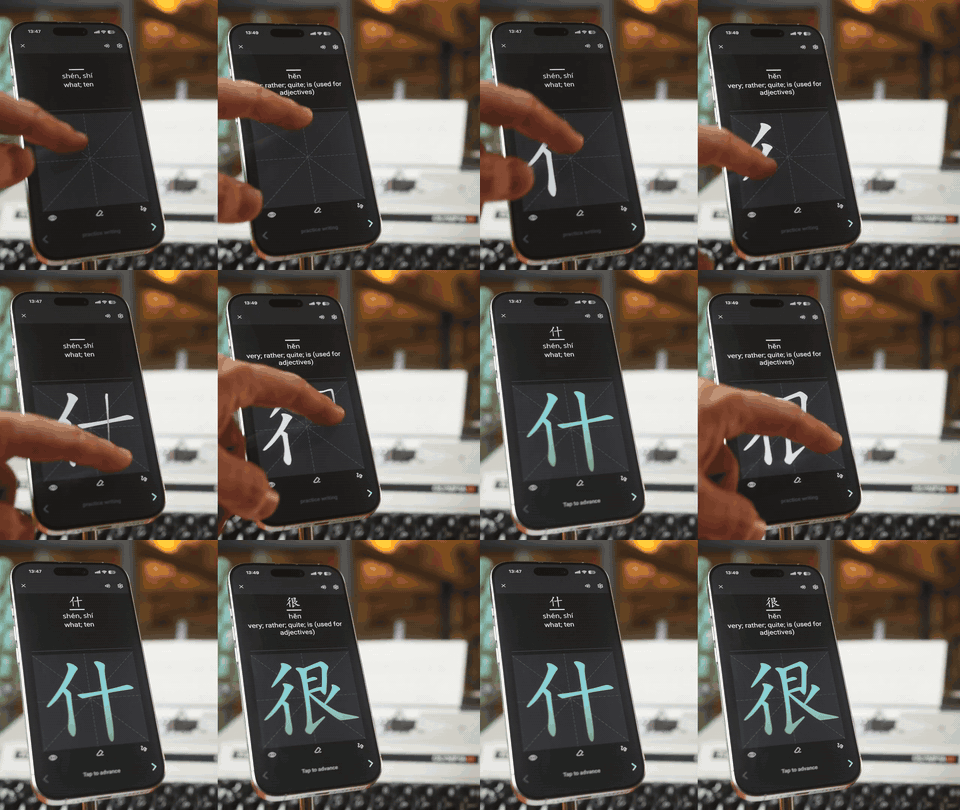
Some components look very similar but mean very different things. 亻 (person), as in 什么, and 彳 (step), as in 很, are a good example. The lid radical in 字 is also different from the one in 写. Those little dots and pokey-out bits matter.
From the released mock papers, Fiona doesn’t get the sense that the exam is trying to trick you by putting two very similar options side by side. The components in the multiple choice have looked fairly different so far. That doesn’t mean a future paper won’t do it, so be mindful when you write.
When you’re reading, you might not even notice that 什 has a 人字旁, the person component. When you’re writing, you have to put down those two strokes. If you use stroke snapping in Skritter, it won’t let you move on until you’ve got them right. Keep that mode on when you’re first learning a character.
The most tested components
Fiona listed the practice questions at the end of the workbooks and looked at as many mock papers as are available now. Some components simply come up more often, because more characters in that 100-character list share them. The top three for the HSK 1-2 writing exam are the walking radical 辶, the woman radical 女, and the person radical 亻. Give those extra attention when you practise.
Tips for Part 2
Same sound? Use the context
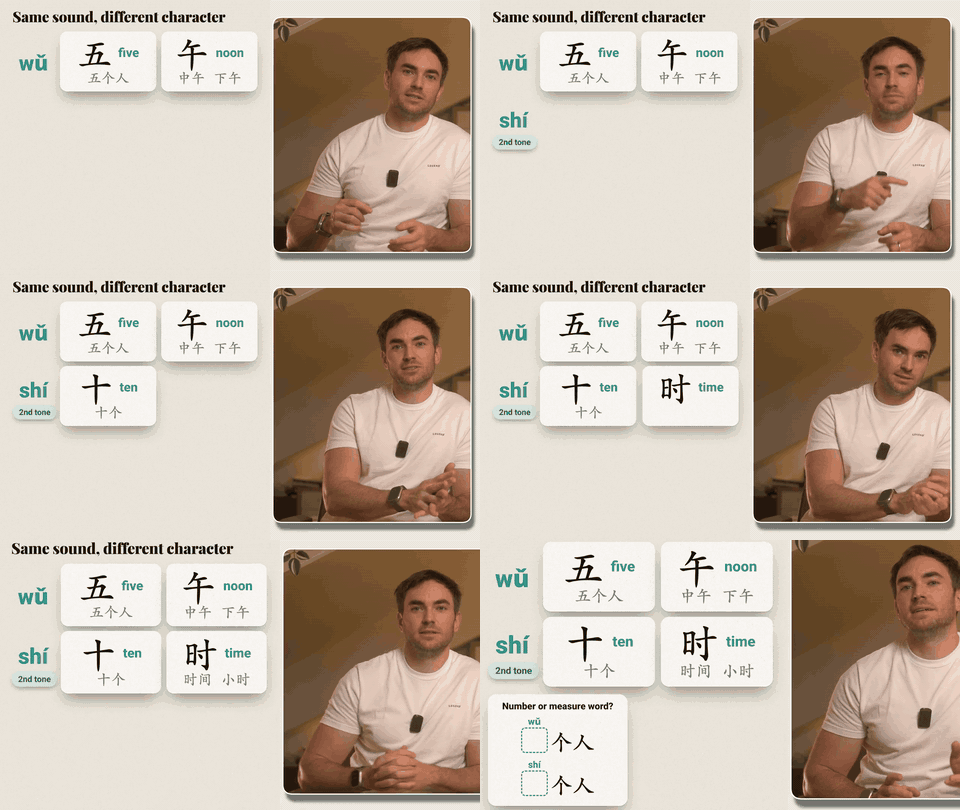
Because you’re given the pinyin, you have to watch out for characters that sound the same. Is it 五 (wǔ, five) or 午 (wǔ, noon)? Is it 十 (shí, ten) or 时 (shí, time), as in 时间 or 小时? If there’s a number or a measure word next to the blank, think five or ten. If the sentence is about time, think 午 or 时.
Always check the tone mark
Always, always, always check the tone mark. If Fiona were prepping you for this exam, she would get you to physically circle it so you don’t skip it. In the HSK 1-2 100-character list, there are sounds that look similar on the page but have different tones. Miss the mark and you might write the wrong character.
A useful pair is 国 (guó, country) and 过 (guò, to pass). Others to watch are 八 (bā, eight) and 爸 (bà, father), and 大 (dà, big) and 打 (dǎ, to hit).
Learn whole words, not just single characters
Even though you’re only tested on single characters, learn the accompanying vocabulary: 国家 (guójiā, country), 写字 (xiězì), and so on. That’s why the HSK 2 (2025) word list is so handy alongside the handwriting deck.
How to practise with Skritter
You could prepare by writing each of these 100 characters out ten times. A better way is a spaced repetition app that focuses on handwriting, so you can practise on the subway or before you go to sleep, and you’re not copying out characters you already know.
If you are sitting the paper exam, you will still need to write with a pen, so it’s worth practising on paper too. We’ll have a write-along-with-me video for that. You just can’t always be somewhere with a notebook, which is where Skritter helps.
We keep the handwriting lists as their own decks, separate from the main HSK word lists, because they serve a different purpose and you can turn on different study modes. You don’t have to learn the same characters twice: what you learn in the handwriting deck is reflected in the HSK 2 deck, and in other decks if you tap Rejuvenate.
Start with the handwriting decks
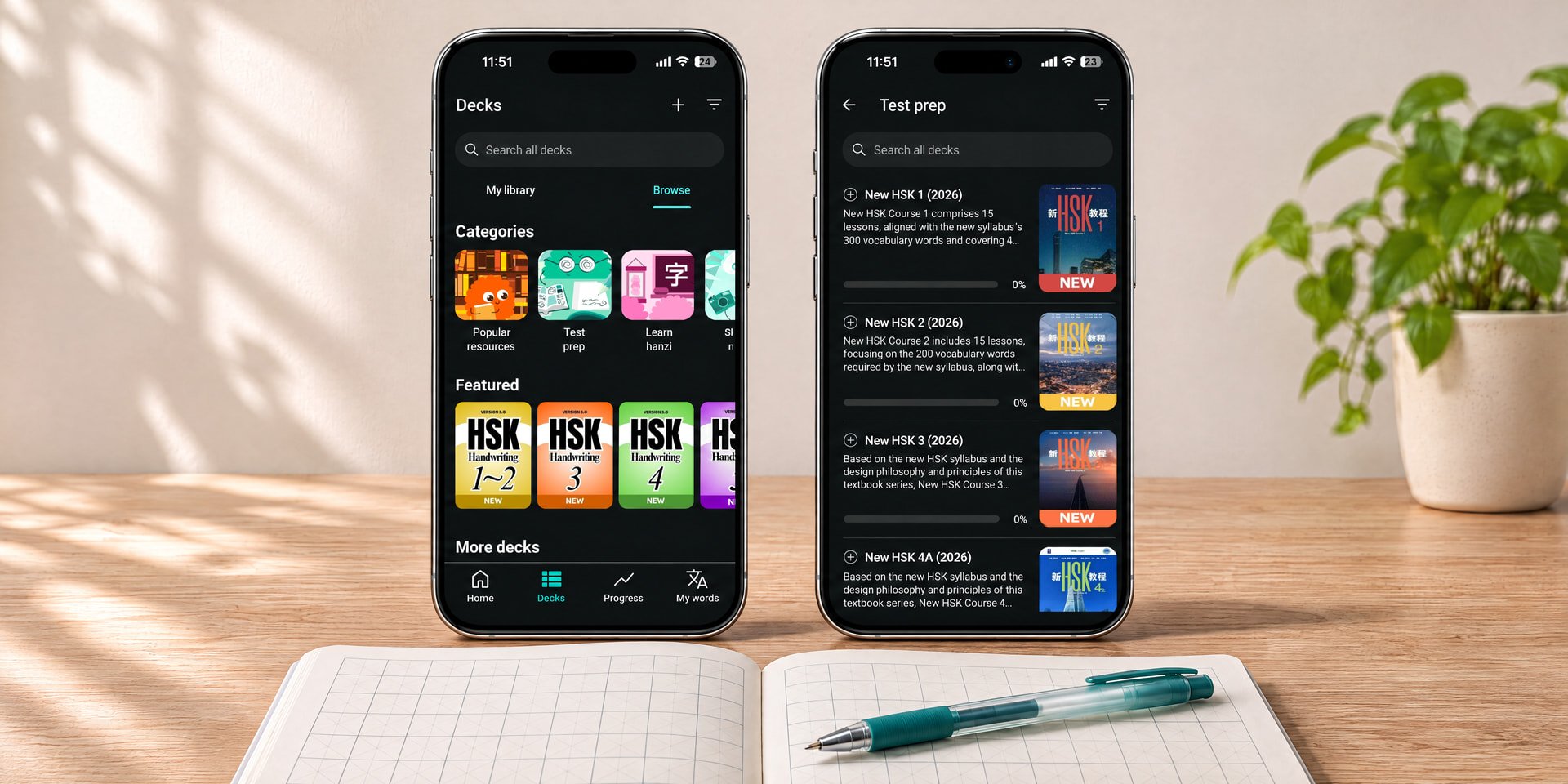
The best place to start for HSK 2 is the HSK 1-2 Handwriting (2025) deck. Type “HSK” into search in the app, or look in the Test prep section. We’ve also published handwriting decks for the higher levels, and we’ll be releasing a writing-exam video for each of those too, one level at a time.
- HSK 1-2 Handwriting (2025)
- HSK 3 Handwriting (2025)
- HSK 4 Handwriting (2025)
- HSK 5 Handwriting (2025)
- HSK 6 Handwriting (2025)
- HSK 7-9 Handwriting (2025)
Use Test Mode
Test Mode is the closest thing in Skritter to a real exam. It turns off the spaced repetition algorithm and works more like a classroom test. Open your HSK 1-2 handwriting deck, pick a section or the whole deck, then tap Test. You can uncheck words you’re already sure of, and change the other test options as you like.
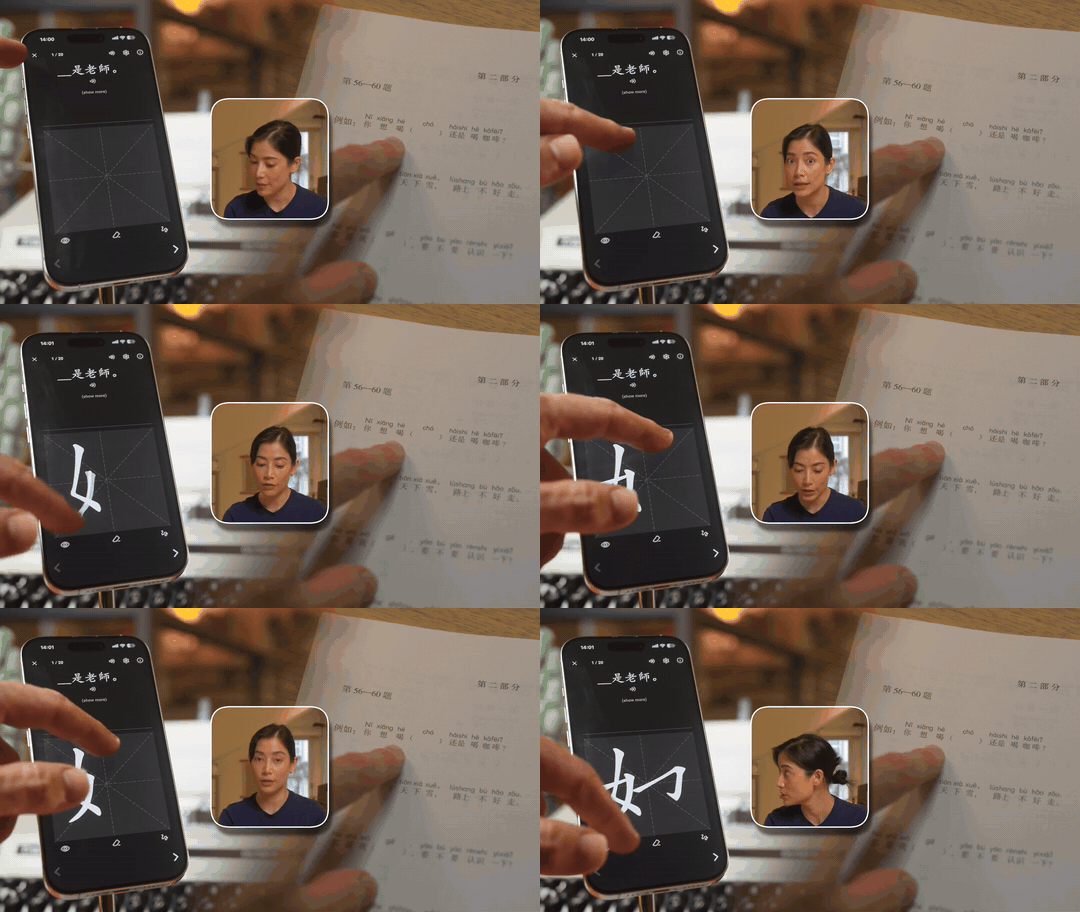
Once the test starts, swipe from left to right to reveal the example sentence. That’s about as close as you can get to doing the exam, and then you write out the character. If you just want to write a character on repeat, the default study mode is very good. And if there are characters you keep forgetting, customise your mnemonics so the stories actually work for you.
A little writing every day will help you more than cramming. Spaced repetition is what makes handwriting stick.
If you want more on how to study, have a look at our Study Smarter series on YouTube. And if you’re preparing for the HSK 2 writing exam, tell us in the comments which level you’re aiming for.
Ready to start? The HSK handwriting decks are on Skritter. Download the app and begin with the 100 characters for HSK 2.