

Have you ever eaten durian? Seen a UFO? Or visited the beautiful island of Taiwan? In Mandarin Chinese, when we want to talk about these kinds of life experiences, we use a very specific grammar tool: the particle 過 / 过 (guò).
Many learners get confused between 了 (le) and 過 / 过 (guò). While 了 often focuses on the completion of an action (like “I ate dinner”), 過 / 过 is all about life experience. It focuses on whether something has happened at least once at an undefined point in your past.
The Basic Structure: Verb + 過 / 过
The basic structure for telling someone you have done something is straightforward:
Subject + Verb + 過 / 过 + Object
Unlike English, you don’t need to specify exactly when the event happened. The presence of 過 / 过 already implies the experience is part of your history.
- 我去過台北 / 我去过台北。
- Wǒ qùguò Táiběi.
- I have been to Taipei.
- 我吃過臭豆腐 / 我吃过臭豆腐。
- Wǒ chīguò chòudòufu.
- I have eaten stinky tofu.
How to Say You HAVEN’T Done Something
If you want to say you have never done something, remember this golden rule: Don’t use 不 (bù)!
Because we are negating an experience in the past, we use 沒 / 没 (méi). While 不 is typically used for present or future habits, 沒 / 没 negates the action itself in this context.
- 我沒去過紐約 / 我没去过纽约。
- Wǒ méi qùguò Niǔyuē.
- I have not been to New York.
- 我沒學過法文 / 我没学过法文。
- Wǒ méi xuéguò Fǎwén.
- I have not learned French.
To emphasize that you have never, ever done something in your entire life, add 從來 / 从来 (cónglái):
- 我從來沒吃過蛇肉 / 我从来没吃过蛇肉。
- Wǒ cónglái méi chīguò shéròu.
- I have never (ever) eaten snake meat.
Adding Frequency: How Many Times?
Sometimes simply saying “I have done it” isn’t enough—you want to say how many times. To do this, we use the frequency measure word 次 (cì).
- 我去過鼎泰豐三次 / 我去过鼎泰丰三次。
- Wǒ qùguò Dǐng Tài Fēng sān cì.
- I have been to Din Tai Fung three times.
If you want to emphasize that it was only one time, you can add 只 (zhǐ):
- 我只去過一次 / 我只去过一次。
- Wǒ zhǐ qùguò yí cì.
- I have only been once.
Asking Questions About Experience
There are two common ways to ask someone about their life experiences.
Option 1: The 嗎 / 吗 (ma) Pattern
Simply add 嗎 / 吗 to the end of a statement.
- 你看過這本書嗎 / 你看过这本书吗?
- Nǐ kànguò zhè běn shū ma?
- Have you read this book?
Option 2: The 有沒有 / 有没有 (yǒu méiyǒu) Pattern
This “Have or have not” structure is very common in spoken Chinese.
- 你有沒有去過美國 / 你有没有去过美国?
- Nǐ yǒu méiyǒu qùguò Měiguó?
- Have you been to the US?
Key Vocabulary from this Lesson
| Traditional | Simplified | Pinyin | English |
| 過 | 过 | guò | Experience particle |
| 榴蓮 | 榴莲 | liúlián | Durian |
| 飛碟 | 飞碟 | fēidié | UFO |
| 臭豆腐 | 臭豆腐 | chòudòufu | Stinky Tofu |
| 從來沒 | 从来没 | cónglái méi | Never ever |
| 蛇肉 | 蛇肉 | shéròu | Snake meat |
| 次 | 次 | cì | Frequency (times) |
| 只 | 只 | zhǐ | Only |
Summary Table
| Form | Structure | Example (Trad/Simp) |
| Positive | Verb + 過 / 过 | 我吃過 / 我吃过 |
| Negative | 沒 / 没 + Verb + 過 / 过 | 我沒吃過 / 我没吃过 |
| Emphasis | 從來沒 / 从来没 + Verb + 過 / 过 | 我從來沒吃過 / 我从来没吃过 |
| Question | …過嗎? / 有沒有…過? | 你吃過嗎 / 你吃过吗? |
Now it’s your turn! Let us know in the comments how many times you’ve been to Taiwan (or where you want to go) using the 過 / 过 and 次 patterns! 🥟
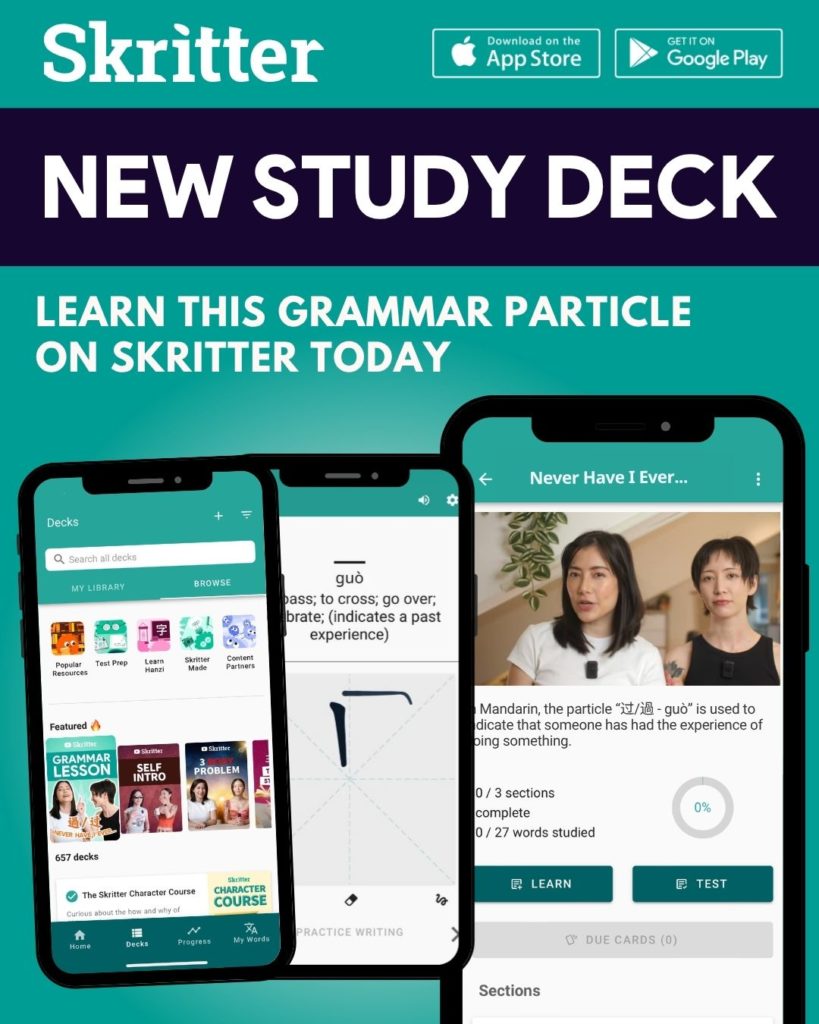
Study the deck on Skritter. Download our app on iOS or Google Play. Open Directly in Skritter here.