
If there is only one Chinese painting you need to know, it is this one: 「清明上河圖」 (Qingming Shànghé Tú), or the Riverside Scene at Qingming Festival.
Created by the Song Dynasty artist Zhang Zeduan (張擇端), this five-meter-long masterpiece is more than just a beautiful landscape. It is a time machine into a 1,000-year-old megacity, a cinematic experience, and—most surprisingly—a daring work of political satire.
Video Lesson Part 1
The World of the Song Dynasty (960–1279 CE)
To understand the painting, you first have to understand the era. While Europe was in the High Middle Ages, the Song Dynasty was experiencing a technological revolution. This period saw the invention of gunpowder, the compass, and movable-type printing.
The setting of the painting is Bianjing (汴京), the Song capital. With a population of over one million people, it was the Tokyo or New York of its time. Unlike other court paintings that depict emperors or myths, Zhang Zeduan focused on the “ordinary”: barbers, doctors, fortune tellers, and even beggars.
You can view an interactive version of the full painting on the Beijing Gugong Museum’s official website
How to “Read” a Handscroll (手卷)
In Chinese art, you don’t just “look” at a painting; you read it.
The format is a shǒujuǎn (手卷), or handscroll. It was never meant to be displayed all at once on a museum wall. Traditionally, you would unfold it shoulder-width, using the “Left Release, Right Roll” (左舒右卷) method. This creates a cinematic, intimate experience where the story unfolds section by section, much like a film reel.
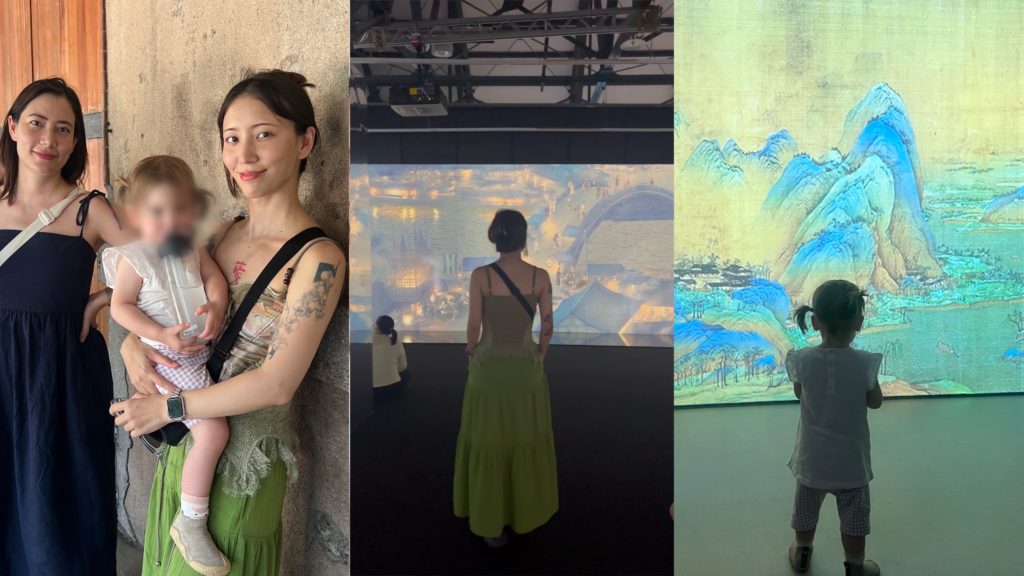
Part 1: Morning Mist and Near Disasters
The journey begins on the outskirts of the city. Out of the morning mist comes a donkey caravan carrying charcoal. As we move deeper, we see the classic Chinese image of 「小橋、流水、人家」 (small bridge, flowing water, and households)—a symbol of peaceful rural life.
But tension is hidden everywhere. Look closely at the willow trees: one is broken and about to crush a passerby. Nearby, a donkey has gone berserk, causing panic in the streets. This isn’t just a “happy” day; it’s a city on the edge.
The Mystery of the Name
- Qingming (清明): Refers to the solar term marking the start of spring and the Tomb Sweeping Festival.
- Shanghe (上河): Refers to the “reopening” of the river. Because the Yellow River flooded easily, the government built dams in winter and removed them during the Qingming Festival to restart shipping.
The most famous scene occurs at the Bian River (汴河). A massive ship is about to crash into a bridge because the navigator isn’t looking ahead. Onlookers scream and throw ropes—a dramatic metaphor for a society losing its direction.
Part 2: Camels, Lazy Soldiers, and Satire
As we pass through the city gates, we see camels (駱駝) from foreign merchant caravans. While they represent prosperity, they also represent a security risk. In the Song Dynasty, foreign traders were supposed to be inspected, but the soldiers at the gate are slacking off—one is even caught napping on the ground!
This is where the deeper meaning of the painting emerges. In Chinese, “Qingming” also means “Political Clarity” (政治清明). By showing us broken trees, near-shipwrecks, and lazy guards, Zhang Zeduan was actually criticizing the government’s poor management and internal weaknesses.
The Warning at the Crossroads
The painting ends at a medical clinic with a sign that reads: 「治酒所傷」 (Treating injuries caused by alcohol).
After passing countless wine houses and bars (including the Song Dynasty version of “Foodpanda” delivery!), this final scene serves as a warning to the Emperor: Indulgence and negligence lead to the weakening of the state.
Why the Original Song Version is Unique
Later copies of this painting from the Ming and Qing Dynasties are more colorful, but they often remove the “grit.” The Qing version, for example, was painted for the Qianlong Emperor and shows only a harmonious, perfect world.
The Song original is special because it was created at the Hanlin Academy, suggesting that even in a troubled era, the Song government allowed space for critical, scholarly voices.
Key Vocabulary Table
| Chinese (Trad/Simp) | Pinyin | English Definition |
|---|---|---|
| 清明上河圖 / 清明上河图 | Qīngmíng Shànghé Tú | Riverside Scene at Qingming Festival |
| 手卷 | shǒujuǎn | Handscroll (painting format) |
| 宋朝 | Sòngcháo | Song Dynasty |
| 汴京 | Biànjīng | The capital city (modern-day Kaifeng) |
| 汴河 | Biànhé | Bian River / Canal |
| 二十四節氣 / 二十四节气 | èrshísì jiéqì | The 24 Solar Terms |
| 駱駝 / 骆驼 | luòtuo | Camel |
| 政治清明 | zhèngzhì qīngmíng | Political clarity / Good governance |
| 諷刺 / 讽刺 | fěngcì | Satire / To satirize |
| 翰林圖畫院 / 翰林图画院 | Hànlín túhuàyuàn | Imperial Painting Academy |
Ready to Master Classical Chinese?
If you want to dive deeper into the language of history and art, we’ve prepared a Skritter Deck featuring all the advanced vocabulary mentioned in this lesson. Master these terms, and you’ll be ready to watch any historical C-drama without subtitles!
[Download the Skritter Deck Here]
Study the deck on Skritter. Download our app on iOS or Google Play. Open Directly in Skritter here.
Don’t forget to subscribe to our newsletter for more deep dives into Chinese culture and language!