
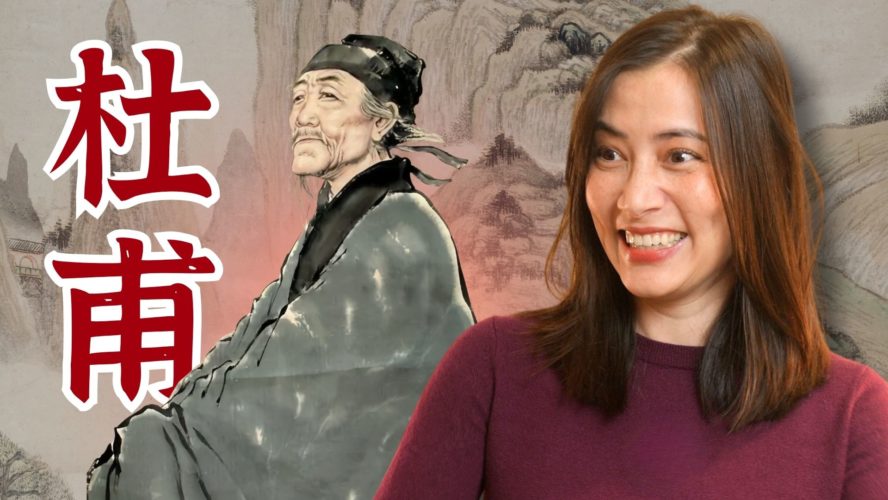
When we talk about ancient Chinese poetry, two names almost always go hand in hand: Li Bai (李白) and Du Fu (杜甫). Together, they are known as 「李杜」(Lǐ Dù).
While Li Bai was the romantic “Poet Immortal” who dreamed of the heavens, Du Fu was the grounded “Poet Sage” who witnessed the harsh realities of the earth. Living during the decline of the Tang Dynasty, Du Fu didn’t just write beautiful verses; he documented history.
A Voice for the Common People
Du Fu’s life was marked by struggle. Despite being born into a prestigious family, he failed the imperial exams multiple times and lived in poverty. Because he experienced war and displacement firsthand during the An Lushan Rebellion, his poetry became a voice for the voiceless.
One of his most powerful lines critiques the massive wealth gap of the time. After witnessing his own son die of starvation while the wealthy feasted, he wrote:
「朱門酒肉臭,路有凍死骨。」
Zhūmén jiǔròu chòu, lù yǒu dòngsǐ gǔ.
“At the grand vermillion gates, wine and meat spoils, while the road outside is paved with frozen bones.”

Study the deck on Skritter. Download our app on iOS or Google Play. Open Directly in Skritter here.
Masterpiece: “Spring View” (春望)
Before fleeing the capital city of Chang’an during the war, Du Fu wrote Spring View. It captures the contrast between the eternal beauty of nature and the crumbling state of human society.
This raw honesty is why his work is called “Poetic History.”
「國破山河在,城春草木深。」
The nation is shattered, yet its mountains and rivers remain;
Spring returns, but the city’s vegetation grows wild and untended.
「感時花濺淚,恨別鳥驚心。」
Saddened by the times, I weep at the flowers;
Tormented by partings, even the birds startle my heart.
「烽火連三月,家書抵萬金。」
The war has lasted three months; a letter from home is worth its weight in gold.
(Note: This is widely considered the most famous line of the poem).
「白頭搔更短,渾欲不勝簪。」
I scratch my graying hair, now so sparse that it won’t even hold a hairpin.
The Legacy of the Sage
Du Fu passed away in poverty on a boat at the age of 58, but his legacy is immense. He is revered not just for his technical skill, but for his compassion. He asked the hard questions about why society allows suffering, and he maintained his integrity when it would have been easier to “slap the horse’s butt” (flatter the emperor).
His poetry reminds us that even in the darkest times, human beings continue to pursue justice and hope.